

Why AI Valuations Are Derailing Exits

Picture this: lying on the sunbed of a beautiful yacht with a wonderful book in hand, a wide-brimmed hat and a chic one-piece swimsuit… like you could be in a commercial or a magazine (at least that is what I would we wearing!). The sunbed sits at the front of a big yacht with multiple staterooms where your friends and family can come and hang out as you tour beautiful locations and enjoy beautiful food and vistas. All of this is thanks to the business you built and will sell in the future.
And thanks to a recent AI valuation, you've realized this dream may be a reality and that this boat may be something you can actually buy. So you start researching and dreaming. You have, as a mentor once told me, bought the boat in your mind. Next, you find an M&A advisor or investment bank who says they can deliver what you are hoping, and you go to market to make the dream real. In the process of finding an advisor, you ignore the advisors / groups who said the valuation should be lower than your AI derived number…you chalk it up to an unscrupulous set of groups who were trying to under sell you to make their jobs easy…and you went with the one group who said they could deliver.
You expected to sell your business for $30M based on what AI informed you was a sure thing. Once you go to market, you receive five offers, all around $18M, with a similar set of reasons for the reduced valuation versus what you expected. Sure, $18M is a great outcome, but it's not the $30M you told your spouse you would sell the company for, and it's not enough to buy the yacht you inquired about and have been in touch with the boat broker about.
Now you need to make a decision. Do you sell for $18M, or do you hold on to the company and wait for the buyer who understands the right valuation, which is closer to $30M? You have researched comparable multiples, and based on your industry you are likely around 5–6x EBITDA, which gets you closer to $18M. But your company is different, and it should get the 8–9x EBITDA multiple that AI told you was a given.
It's a tough decision. Unfortunately, the predicament you are in is the result of a valuation that was incorrect and skewed, one that did not account for the many factors that influence exit multiples, and of the psychological framing that followed from it.
This story is fictitious, but the underlying reality is not. We've talked to numerous potential clients who share similar beliefs and find themselves in similar situations, whether or not they care to admit it.
The Hardest Question We Get Asked
One of the most challenging questions potential sellers ask us is: what do you think my company can sell for?
It's a challenging question because it is highly nuanced, shaped by a huge number of factors, and subject to the old but very accurate adage that a company is only worth what it's worth to a buyer. We can give ranges and guidance based on available data, on what we understand of the company's nuances, and on our own transaction results in a given industry. But it has become apparent that sellers are increasingly turning to AI to help answer this question.
Valuing a lower mid-market company is a genuinely hard task. Unlike selling a house, where you can see what comparable homes are listed at and have historically sold for, most of the data in mid-market M&A is private. The few times reliable public data is available, it is often skewed, because it tends to involve publicly traded companies buying privately held ones. That skews the for three reasons:
- Public acquirers can afford to pay more on average, particularly when shares form part of the consideration.
- They are usually strategic buyers acquiring for strategic purposes, and strategic buyers typically pay more than financial buyers such as private equity.
- They tend to acquire companies at the larger end of the mid-market range (at RWT, we define the mid-market as $7.5M to $200M).
Why AI Gets Valuations So Wrong
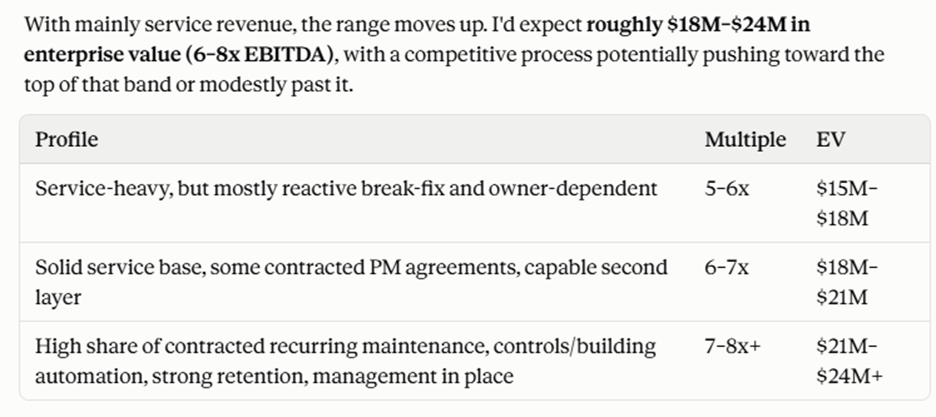
One reason AI gets valuations so wrong is that it relies heavily on the business owner's inputs, which means its valuation is usually built on incomplete data. Most business owners don't know which specific factors and data drive value, so they don't provide them. Here is an example I quickly ran through Claude.
Input 1: We are thinking of selling an M/E contractor doing $15M in revenue and $3M in EBITDA in Canada with mainly service revenue. What valuation range should we expect?
Response 1:
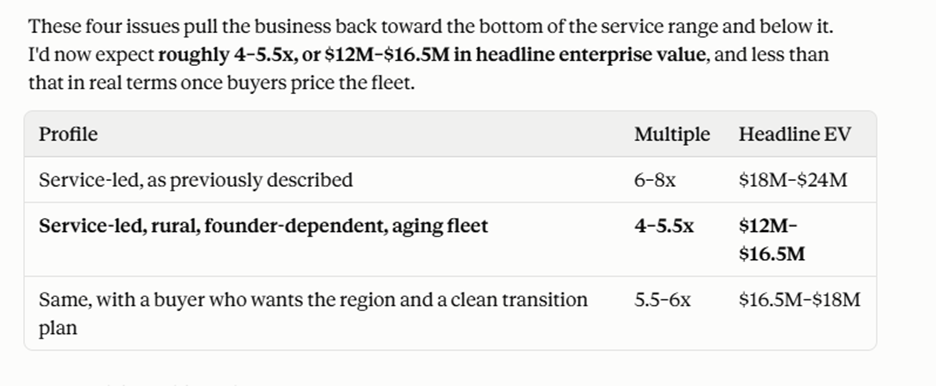
Input 2: For this business, the company is actually located in a rural location, they have no formal sales team, are heavily reliant on the founder, and the majority of their equipment is older and may need replacing.
Response 2:
Input 3: Can you verify this valuation against Canadian M&A trends and year-to-date publicly available data, and if using a public company reference, apply an adequate discount to public markets based on published public-to-private liquidity discounts? Please use TSX data only.
Response 3:
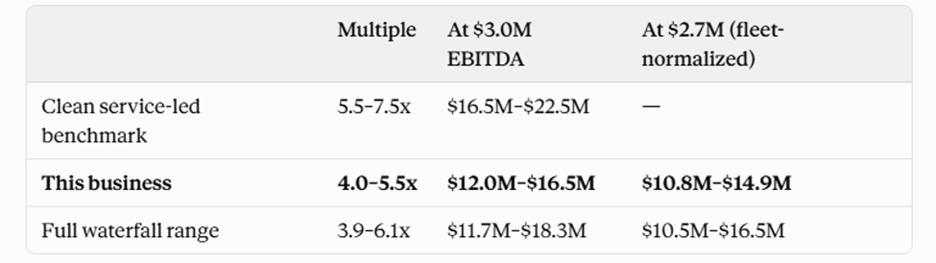
Across the three inputs, the valuation range dropped from $18M–$24M, to $12M–$16.6M, to $10.8M–$14.9M, simply because I kept asking Claude to account for more factors.
This matters because most of the business owners I speak with only enter one set of inputs. They fail to consider the nearly countless variables that affect what a business actually sells for. There are enough of them to fill another article, but the reality is that entering limited information is a surefire way to receive a badly inaccurate valuation.
More Information Won't Fix It
You might read this and think the fix is simply to give AI more information. It isn't.
Even my third prompt, which covered the rural location, founder dependence, aging equipment and a TSX-based liquidity discount, still produced a number built on the same weak foundation: public market data adjusted by a generic formula. It never saw what a rural Canadian M/E contractor with no sales team actually sold for last year, because that deal was private, like almost every deal in the mid-market. AI can only reason from what's published, and here the most important information never is.
AI doesn't know which buyers are active in your sector right now, what they paid for their last three acquisitions, how they structured those deals, or which risks they will price most heavily. It can't tell you that the same $3M of EBITDA is valued very differently depending on whether a strategic buyer, a PE platform or a family office is on the other side of the table.
More detail makes AI less wrong. It doesn't make it right.
What Real Transactions Tell Us
That knowledge comes from doing deals. Across more than 130 mandates in 16 countries and over $3 billion in transaction value, we've seen what buyers actually pay, not what a model estimates they should.
Experience shows that final value depends on factors no model captures:
- How many credible buyers are competing
- How well the business was prepared before going to market
- How the deal is structured, including cash at close, earnouts, vendor notes and rollover equity
- When and how the business is marketed
- How cleanly due diligence goes
Two companies with identical EBITDA can close several turns apart on those factors alone. The headline multiple AI quotes also says nothing about how much of the price arrives on closing day. When we give an owner a range, it is anchored in what comparable businesses have actually closed at and what today's buyers are prepared to pay.
Why a Wrong Valuation Costs More Than You Think
At face value, an inaccurate valuation doesn't sound like a terribly big problem. Psychologically, it is a much bigger one than it appears.
An inflated valuation changes decisions. Once an owner has anchored to $30M, told their spouse, planned their retirement around it and bought the boat in their mind, every offer gets measured against that number instead of against the market. Five consistent offers at $18M should be the clearest signal a seller ever receives: that is what the business is worth today. To an anchored seller, it feels like losing $12M, and it feels like the process was a failure with buyers who dont understand what their company is worth.
That's when costly mistakes happen. Owners turn down strong offers. They pull the business off the market to wait for the buyer who "gets it," and that buyer rarely exists. Deal momentum dies, and the buyers who walked away remember it. Meanwhile, the business keeps operating in the real world. A key customer leaves, margins tighten, rates shift, and the owner gets another year more tired. A company that could have sold for $18M may be worth $15M two years later. The wrong number didn't just cost that owner the boat. It cost them the $18M exit too, and more importantly, it cost them time they can never get back.
Burning Daylight
I grew up watching cowboy movies, many of them black and white, and many of them featuring the notorious John Wayne. You would likely be surprised to know that I have probably watched more John Wayne movies than most women my age. I generally did not understand the story lines, and I am not advocating for the films or the man himself, but as a kid I loved them. Years later, in one of his colour pictures, I came across a line that has stayed with me ever since: "We're burning daylight."
Even as a child, that sat with me. Daylight is a fleeting thing. To a far more significant degree, so too are our lives. Oliver Burkeman frames it well in Four Thousand Weeks: that is roughly all any of us get. If you are reading this and you are middle-aged, you have about two thousand left. It is the one thing that, no matter how much money you make from your business or how much you grow it, presents a hard trade-off that every business owner must face. And time, unlike money, is priceless.
We were once asked to provide a proposal to sell a machining company owned by an 85-year-old man who had run the business for more than forty years. The company was worth somewhere in the range of ten million dollars, and I thought this would be an easy client to sign… after all, he was 85. We met, we talked through the process, and a few days later he came back to us and said it was not the right time. He was going to keep operating the business for a few more years....A few more years. At 85.
In my opinion, AI Valuations are reducing the likelihood that mid-market business owners can actually enjoy the fruits of their labours and build the legacy I have talked oh so much about. In a way, its providing a theoretical upside that feeds the ego while simultaneously stealing their fleeting time.
There is a passage I have always liked, usually attributed to the Dalai Lama although its actual origins are murky, about the strange rituals human beings inhabit. The idea is that we sacrifice our health to make money, then spend the money trying to recover our health, and are so anxious about the future that we never inhabit the present, and so we end up, in the phrase that closes it, having "never really lived." Whoever first said it, the observation is sadly true for a great many business owners.
So when an owner turns down $18M to wait for $30M, what I hear is that they are spending years of their health span waiting for a number the market has already told them it will not pay.
AI valuations have quietly become one of the most significant threats to business owners achieving strong exits and capitalizing on the value of what they have built. If you have used AI to estimate what your company is worth, treat that figure as the start of a conversation, not the answer.
The number that matters is the one a real buyer will pay, on terms you can live with, while you still have the health and time to enjoy what comes next. If you're weighing an exit, talk to an advisor who has actually closed deals in your sector and more importantly someone who can tell you the truth about the market…not just what you want to hear. This is the starting point to getting a deal done.
