

Rising Interest Rates & The Impact on Mid-Market M&A
.jpeg)
If you've been paying attention to the business news in North America, you recently saw that the US Federal Reserve raised interest rates, on September 16, a quarter-point hike to a 3.75%–4.00% target range, its first increase since July 2023, with its own projections pointing to one more before year-end. In Canada, the Bank of Canada held at 2.25% on September 2, but it said the upside risks to inflation have increased, and the bond market is already moving: the Canadian 10-year yield is sitting near 3.86%, a two-year high. The market is now pricing the Bank of Canada's next move as a hike, not a cut. Whether or not rates continue to go up is another thing, but the sheer notion of increasing interest rates is enough for the hairs on the back of my neck to stand up and for me to write this article, because it is something business owners need to understand when selling their business…(I have battle scars from leading deals through 2022 and 2023, when the Bank of Canada took its policy rate from 0.25% to 4.25% in nine months.)
Understanding the Mechanics of Interest Rates and Mid-Market M&A
Most business owners considering selling their business have very little awareness of the impact that interest rates have on their own exit, the multiples they may receive and what it can mean for the overall ability to get a deal done. More broadly, I would assert that this extends to many of the people who wield influence over business owners thinking of selling…accountants, lawyers, wealth managers and the like.
So why are exit valuations so correlated to interest rates?
Many buyers of mid-market companies rely on debt financing to pay for some element of the transaction (or sometimes nearly all of it at low EBITDA multiple transactions), so the cost of that debt becomes incredibly relevant to the buyer's borrowing capacity. The simple logic is this: a business can only produce so much cash flow, and the buyer intends to use that cash flow to repay the debt it used to fund the purchase. The less of that cash flow that goes to interest, the more principal the buyer can afford to borrow. Therefore, even small changes in interest rates have an outsized impact on the lending capacity of the buyer. As rates go up, the buyer's borrowing capacity decreases, and the buyer then has to decide whether to a) simply offer less for the business because they can borrow less, b) offer the same amount but bridge the gap using various structural tools, or c) make up the difference with cash, which may sound like the easy option but, from experience, is often the least chosen by mid-market buyers (normally due to a lack of available cash the buyer themselves has to put into the transaction).
A Simple Scenario
Consider a business generating $5 million of EBITDA, with an owner seeking a $30 million (6.0x) total transaction value. After capital expenditures and taxes, roughly $3.75 million is left as free cash flow. A cash-flow lender will typically want a cushion of about 1.25x coverage on that, which caps what the buyer can spend on debt payments, principal plus interest, at about $3 million a year. Assume a seven-year term loan priced at prime plus 2.5%, and a buyer who has $12 million of cash to put in into the transaction.
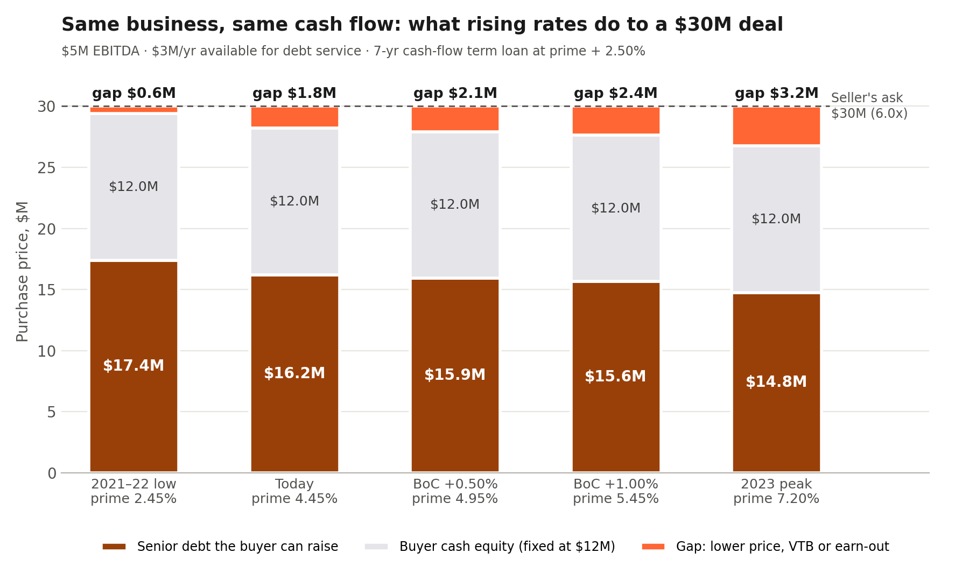
Illustrative only. Canadian prime at each point in time; the buyer's cash equity is held constant so the effect of rates alone is visible.
Nothing about the business changes across those five bars…same earnings, same buyer, same cash in hand. Only the rate changes. At 2021–22 rates, the buyer could raise about $17.4 million of debt and was within $0.6 million of the asking price. At today's prime of 4.45%, that falls to $16.2 million and the gap triples to $1.8 million. If the Bank of Canada moves up a full point, the gap is $2.4 million; at the 2023 peak, it is $3.2 million, which is more than five times what it was at the bottom. In this scenario, every 1% move in prime takes roughly $550,000 of borrowing capacity away from this buyer, or a little over a tenth of a turn of EBITDA.
In order to achieve the $30m TTV outcome the business owner wanted, the funding gap cannot simply disappear. Someone has to fund it, and in the mid-market, that someone is usually the seller.
What is perhaps more of an issue than simply less debt being available to a buyer is that it will do one of two things to the owner looking to sell. First, it may mean a lower exit multiple or transaction value, as the buyer simply lowers the price accordingly. Second, and more challengingly, buyers will look to bridge the valuation gap caused by reduced borrowing capacity through a myriad of transaction structures such as earn-outs, vendor take-backs (VTBs), share rollovers and the like. Neither is ideal, as both lower the cash on close for the owner. These mechanisms can also add complexity to the transaction, and complexity in mid-market M&A deals can create problematic outcomes if not managed properly.
The data tracks. Across US private-equity-backed deals in the $10 million to $500 million range tracked by GF Data, the average purchase multiple held at 7.2x EBITDA in both 2024 and 2025, even though senior debt that once cost around 6% now costs close to 10%. What changed was the capital structure: average total leverage fell from 4.0x EBITDA in 2021 to 3.6x in 2025, and buyers made up the difference elsewhere. In other words, the headline multiple is the last thing to move. Structure, and the seller's cash at close, move first; which is exactly why an owner comparing offers on headline price alone can be misled.
A VTB deserves particular attention here, because it turns the seller into a lender. That note will almost always sit behind the bank, be postponed if the business misses its covenants, and carry a rate that rarely compensates for that risk. The terms…interest rate, security, what triggers a payment stop, and what happens on a default…matter as much as the dollar amount.
Buyer Sentiment
Yet in all of this, it's important to recognize that most lenders will not offer a fixed interest rate on a cash-flow-based loan facility (which is what nearly all mid-market M&A financing technically is), so the rate is prime plus a stated spread. As rates go up or down, so does the cost the borrower owes the lender. The issue with this is not so much mechanical as it is sentimental. If the buyer believes rates will keep rising, they may offer even less for a company as a means of protecting themselves should rates continue to go up.
Lenders feel the same sentiment. In a rising-rate environment they don't just charge more; they tighten. Coverage requirements go up, amortization periods get shorter, and the leverage multiple they are willing to lend against comes down. In practice, those credit terms can move a deal more than the rate itself.
There is also timing risk. A mid-market sale typically takes six to twelve months, and a buyer's financing is often not finalized until well after a letter of intent is signed. If rates move between the LOI and closing, the buyer's lender re-sizes the loan and the buyer comes back to renegotiate the price or the transaction structure. This is where many of my 2022–2023 scars came from. We had several deals fall apart overnight as buyers found themselves in precarious situations which caused them to go back to sellers and ask for sizable movements from cash on close into earn-outs, VTB’s and share roll overs. In particular, we had one client who manufactured glazing products for high-rise towers who, in a matter of months saw a $30m deal shrink to a $25m deal, and then lower only for the deal to fall apart as the buyers operating lines were called as a result of the company being offside from a covenant perspective (and they were themselves exposed to construction activity which shares a very close relationship to interest rates as well).
Not All Buyers Are Equally Exposed
Interest rates do not impact every buyer the same way. A strategic acquirer with a strong balance sheet, or a private equity fund with committed capital in the form of a fund, can absorb a higher cost of debt far more easily than an independent sponsor or an individual buyer who is financing most of the purchase. In a rising-rate market, those better-capitalized buyers often win deals simply because they can close with less debt. For an owner, this makes the composition of the buyer pool, not just the number of buyers, one of the most important levers in the process and something we focus heavily on at RWT Capital.
The cross-border picture matters too. With the Fed now at 3.75%–4.00% and the Bank of Canada at 2.25%, US prime is 7.00% against 4.45% in Canada. A Canadian buyer financing with a Canadian lender currently borrows meaningfully cheaper than a US buyer financing at home. For Canadian sellers who assume a US buyer will always pay more, that is worth factoring in as its likely that the delta between what US buyers can borrow versus Canadian buyers may, in fact, shrink (not withstanding the fact that US borrowers have access to some entirely different borrowing products than buyers in Canada).
What Do 2026 and Beyond Look Like for Rates?
Without commenting on the US political situation, which certainly may throw a massive wildcard into my thoughts on this subject, it looks as though interest rates will go up in Canada, likely beginning in late 2026 or into 2027. Why this is likely comes down to the bond market: long-term yields have been climbing, and if they remain high or go higher, it's likely we will see policy rates increase accordingly and stay high for an extended period of time. Long-term yields matter for another reason as well: they are where the market prices its expectations for future rates, and they feed directly into the cost of any fixed-rate or longer-term financing a buyer uses.
That said, Canada is being pulled in two directions. Oil prices, driven by the conflict in the Middle East, are pushing inflation up. At the same time, new US tariffs following the breakdown of trade talks are weighing on growth; the Bank of Canada's Governor has said they could push fourth-quarter growth below 1%. That tension is why the Bank held in September rather than following the Fed, and why forecasters differ on timing…the C.D. Howe Institute's Monetary Policy Council, for example, favours holding at 2.25% into late 2026 and moving to 2.5% by mid-2027. What I anticipate: the direction is up, the pace is likely gradual, and the era of cheap acquisition debt is not coming back soon.
What This Means If You're Thinking of Selling
Owners can't control rates, but they can control how exposed their sale is to them:
• Know your financeable value before you go to market. Ask your M&A advisor what a lender would actually lend against your cash flow at today's rates, not what a multiple chart says you're worth.
• Make your earnings easy to lend against. Lenders lend on what they can verify. Clean financials, a quality-of-earnings review, and well-supported adjustments widen the pool of buyers who can finance a deal.
• Build a buyer pool that doesn't depend on leverage. This is the most important of all of these points as strategic buyers and well-capitalized funds are less rate-sensitive; make sure they are in the process and the work is done to identify and contact them.
• Compare offers on cash at close, not headline price. Discount VTBs and earn-outs for risk and timing, and negotiate their terms as hard as the price.
• Protect the period between LOI and close. Require financing evidence early, set commitment deadlines, and keep alternatives alive. Deals can easily extend multiple months as a result of financing challenges on behalf of the buyer.
• Don't wait for rates to fall. If the direction is up, waiting is a bet against the market that owners rarely win.
Its important to understand that rates are one of the few forces in a sale that neither the buyer nor the seller controls, which is exactly why they need to be planned for.
Sources: Federal Reserve FOMC decision, September 16, 2026; Bank of Canada rate announcement, September 2, 2026; Government of Canada 10-year yield, September 23, 2026; C.D. Howe Institute Monetary Policy Council; GF Data via CIBC US Middle Market Monitor, Q1 2026. Scenario is illustrative.
Reece Tomlinson is the Founder and CEO of RWT Capital Corp. and the Author of Uncommon Capital.
